Monday, June 30, 2014

Tuesday Poem - 'Midday Gavotte' by Alex Skovron


MIDDAY GAVOTTE
‘a duet in which the other instrument is silent’  
                                                       — Henry Miller
                             
His fiddle burns in the sun
as the shoppers crowd around to listen,
looking for the hat. He has come

out of nowhere, his teeth are missing
and his oversize jacket
wriggles with the music, and he glistens

with sweat. His violin is lacquered
a brilliant ochre, the bow
dances, and the eyes bestow a regular rapid

smile (not the lips though),
and the little stool that he perches upon
is almost comically too low,

and a second almost identical one
stands empty a foot away.
Just then he nods at the invisible companion,

sniffs, and ceases to play –
but continues tapping out the colourful beat
with his bow; he nods again

and smiles surprisingly, his absent teeth
gaping, as if in pride
at so adept a partner, steals a fleet

inspection of the financial side
of the performance but continues conducting.
All at once he nuzzles high

into his instrument, slyly whispers something
to the second fiddle: with a poetic
toss he resumes his own song, disrupting

the loud silence of traffic,
all the unseen migrations, the mall’s frenzy;
the audience is clapping

as if in appreciation of the tacit cadenza
just concluded – then sever
slowly, diplomatically from the climaxing dancer
 
to go about their day. Weather
is turning: he stops, collects his disconsolate chum
and they walk off the stage together.

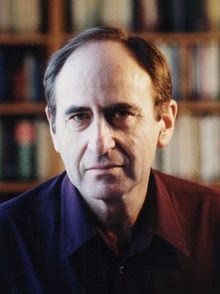
Alex Skovron


I finally caught up with Alex Skovron's 2003 book The Man and the Map (Five 
Islands Press). I googled and you can still pick up copies here and there, or if you
bump into Alex around the Melbourne traps you might be able to score one off him,
like I did. That was a great night the Melbourne Poets Union put on at The Architect's
Basement, and I came away with an excellent book. I mean, I knew Alex was a fine 
poet, just I had never got round to sitting down to a book of his. You know how it
is. And now I want more, and I want to hear Alex read his work. I just haven't heard
him read as much as I would like. I often bump into him, like he bought me a coffee
at a reading at Fed Square (I owe you a coffee, Alex, must remember for next time
we meet) but he is not up on his hind legs in front of the microphone as much as one
would wish.

Sunday, June 22, 2014

Tuesday Poem - Cargoes by John Masefield


CARGOES

Quinquireme of Nineveh from distant Ophir,
Rowing home to haven in sunny Palestine,
With a cargo of ivory,
And apes and peacocks,
Sandalwood, cedarwood, and sweet white wine.
Stately Spanish galleon coming from the Isthmus,
Dipping through the Tropics by the palm-green shores,
With a cargo of diamonds,
Emeralds, amythysts,
Topazes, and cinnamon, and gold moidores.
Dirty British coaster with a salt-caked smoke stack,
Butting through the Channel in the mad March days,
With a cargo of Tyne coal,
Road-rails, pig-lead,
Firewood, iron-ware, and cheap tin trays.


Because I am reading 'Now All Roads Lead To France' by Matthew Hollis,
which is about the last years of Edward Thomas, my mind has turned back
to the poets of that time. Edward Thomas seemed to be right in the thick
of the scene, (he reviewed poetry before he began writing it himself -
encouraged on by Robert Frost, who was visiting England with his family),
and all the poets I have ever heard of from that time are in the book. 
Walter de la Mare, Eleanor Farjeon, Yeats, Pound, Abercrombie 
Lascelles etc etc, and Masefield.
'Cargoes' is a poem I came upon at a very young age, and liked very 
 much, I became almost drunk on the sound of the words and the beating
 rhythm, and that final triumphant shout of – 'cheap tin trays'! In my found 
object art making stage I did a piece called 'Cheap Tin Tray”. I've chosen 
'Cargoes' this week because I thought maybe these days the work of 
Masefield and his ilk are not so easily come across. Maybe some people 
don't know it.
http://en.wikipedia.org/wiki/John_Masefield

Monday, June 16, 2014

Tuesday Poem - Two Poems by Claire Gaskin


sandstone shelter

in the language of slammed doors
the loudest slam means acceptance

his palm reminds me of rain puddling
in the plastic chairs behind the flats

I hear the screeching brakes
of a swan etched on a mirror

rank betrayal with the metronome

what holds us together lasts longer than we do

I put my hands into the silences of my pockets


yes

you don't slam the door until I'm two flights down
please find a reason not to self-destruct
my knees are crumbling like sandstone churches

I'm cleaning our house of horizons
the pain doesn't forget my body
I don't fear death, yes invented the wheel


What a strange emotional trip Claire Gaskin's new book 'Paperweight'
(Hunter Publishers) is. I read the whole book in a sitting and it had
such an odd effect on me. I zoned out, as I paid the closest attention.
It was trippy. How does she do that!!??

https://www.penguin.com.au/products/9780987580214/paperweight

Monday, June 2, 2014

Tuesday Poem - Your Mother, My Daughter, And You, Her Son by Jennifer Compton


Your Mother, My Daughter, And You, Her Son

You don't look like anyone I know, and never have.
But your mother was the same, she always confused me.
She arrived in a hectic rush, as did you, and like you had
set up a beachhead, taken a foothold, in a handy uterus,
uninvited and yet adamant, so all a mother can do is submit.
Both of you loved the rock of a horse cantering underneath.
You are more like your mother than anyone else.

For one moment on the 3D pic they took of you in utero
you were the image of your father, your mother tells me
babies do that because fathers need to know, they lack
confidence. Once the dad is safely hooked the child can
express their own unique understanding of the ancestors.
Nobody ever said babies lacked the rat cunning to live.
Perhaps you are like me and I don’t recognise myself.

Who are you like? I need to pin you to the family tree.
From time to time I catch a facsimile of the sweet smile
a maternal great-uncle would deliver as he bent to press
an oddfellow into my palm. But he was stone-cold bald
and we don’t want that. Or the way you run to enlarge
the circle to include everyone puts me in mind of what
my father would have done. Sometimes, because I am

getting old, I call you the same name that I gave my son.
As if I can reclaim him, pop him back into the stroller,
and out into the beautiful morning and down to the shops.
Not that you are at all like him. I do know your name.
No one else, to my knowledge, has been called Nicholas.
The line branches back to the beginning of everything,
there is no one called Nicholas. That I know of. It’s new.


I wonder how many people in the Antipodes read New Welsh Review.
I'm guessing it's not very many. Anyway, I was asked to draw attention
to the issue my poem was in, and this seemed the best way to do it.
The poem came about because I was talking to a friend on facebook
and she said that grandparenting was such a vital part of many people's
lives, but that one seemed to rarely come upon poems about the role.
And I thought – yeah! I haven't written about it.

https://www.newwelshreview.com/article.php?id=752

Monday, May 26, 2014

Tuesday Poem - The Old Vicarage, Grantchester by Rupert Brooke


The Old Vicarage, Grantchester
(Cafe des Westens, Berlin, May 1912)

Just now the lilac is in bloom,
All before my little room;
And in my flower-beds, I think,
Smile the carnation and the pink;
And down the borders, well I know,
The poppy and the pansy blow . . .
Oh! there the chestnuts, summer through,
Beside the river make for you
A tunnel of green gloom, and sleep
Deeply above; and green and deep
The stream mysterious glides beneath,
Green as a dream and deep as death.
— Oh, damn! I know it! and I know
How the May fields all golden show,
And when the day is young and sweet,
Gild gloriously the bare feet
That run to bathe . . .
                            'Du lieber Gott!'

Here am I, sweating, sick, and hot,
And there the shadowed waters fresh
Lean up to embrace the naked flesh.
Temperamentvoll German Jews
Drink beer around; — and THERE the dews
Are soft beneath a morn of gold.
Here tulips bloom as they are told;
Unkempt about those hedges blows
An English unofficial rose;
And there the unregulated sun
Slopes down to rest when day is done,
And wakes a vague unpunctual star,
A slippered Hesper; and there are
Meads towards Haslingfield and Coton
Where das Betreten's not verboten.

ειθε γενοιμην . . . would I were
In Grantchester, in Grantchester! —
Some, it may be, can get in touch
With Nature there, or Earth, or such.
And clever modern men have seen
A Faun a-peeping through the green,
And felt the Classics were not dead,
To glimpse a Naiad's reedy head,
Or hear the Goat-foot piping low: . . .
But these are things I do not know.
I only know that you may lie
Day long and watch the Cambridge sky,
And, flower-lulled in sleepy grass,
Hear the cool lapse of hours pass,
Until the centuries blend and blur
In Grantchester, in Grantchester. . . .
Still in the dawnlit waters cool
His ghostly Lordship swims his pool,
And tries the strokes, essays the tricks,
Long learnt on Hellespont, or Styx.
Dan Chaucer hears his river still
Chatter beneath a phantom mill.
Tennyson notes, with studious eye,
How Cambridge waters hurry by . . .
And in that garden, black and white,
Creep whispers through the grass all night;
And spectral dance, before the dawn,
A hundred Vicars down the lawn;
Curates, long dust, will come and go
On lissom, clerical, printless toe;
And oft between the boughs is seen
The sly shade of a Rural Dean . . .
Till, at a shiver in the skies,
Vanishing with Satanic cries,
The prim ecclesiastic rout
Leaves but a startled sleeper-out,
Grey heavens, the first bird's drowsy calls,
The falling house that never falls.

God! I will pack, and take a train,
And get me to England once again!
For England's the one land, I know,
Where men with Splendid Hearts may go;
And Cambridgeshire, of all England,
The shire for Men who Understand;
And of THAT district I prefer
The lovely hamlet Grantchester.
For Cambridge people rarely smile,
Being urban, squat, and packed with guile;
And Royston men in the far South
Are black and fierce and strange of mouth;
At Over they fling oaths at one,
And worse than oaths at Trumpington,
And Ditton girls are mean and dirty,
And there's none in Harston under thirty,
And folks in Shelford and those parts
Have twisted lips and twisted hearts,
And Barton men make Cockney rhymes,
And Coton's full of nameless crimes,
And things are done you'd not believe
At Madingley on Christmas Eve.
Strong men have run for miles and miles,
When one from Cherry Hinton smiles;
Strong men have blanched, and shot their wives,
Rather than send them to St. Ives;
Strong men have cried like babes, bydam,
To hear what happened at Babraham.
But Grantchester! ah, Grantchester!
There's peace and holy quiet there,
Great clouds along pacific skies,
And men and women with straight eyes,
Lithe children lovelier than a dream,
A bosky wood, a slumbrous stream,
And little kindly winds that creep
Round twilight corners, half asleep.
In Grantchester their skins are white;
They bathe by day, they bathe by night;
The women there do all they ought;
The men observe the Rules of Thought.
They love the Good; they worship Truth;
They laugh uproariously in youth;
(And when they get to feeling old,
They up and shoot themselves, I'm told) . . .
Ah God! to see the branches stir
Across the moon at Grantchester!
To smell the thrilling-sweet and rotten
Unforgettable, unforgotten
River-smell, and hear the breeze
Sobbing in the little trees.
Say, do the elm-clumps greatly stand
Still guardians of that holy land?
The chestnuts shade, in reverend dream,
The yet unacademic stream?
Is dawn a secret shy and cold
Anadyomene, silver-gold?
And sunset still a golden sea
From Haslingfield to Madingley?
And after, ere the night is born,
Do hares come out about the corn?
Oh, is the water sweet and cool,
Gentle and brown, above the pool?
And laughs the immortal river still
Under the mill, under the mill?
Say, is there Beauty yet to find?
And Certainty? and Quiet kind?
Deep meadows yet, for to forget
The lies, and truths, and pain? . . . oh! yet
Stands the Church clock at ten to three?
And is there honey still for tea?


I came upon this poem in a book I found in a dusty box of books in the sunroom
in my grandmother's house when I was about 14. Maybe I was a tad younger. Or
older. Anyway, I knew his poem – 'If I should die, think only this of me;' etc – and
also – 'the rough male kiss of blankets' – but I had not come upon this one before.
And it really really got to me. Went straight in and stayed there. That's the way of
it, when you're young and falling in love with poetry. Even now I sometimes chuckle
and mutter to myself - 'Where das Betreten's not verboten.' (Where the grass is
not forbidden.) As I didn't know any German I wonder how I twigged what that
meant. Maybe the book was annotated.
Well – this poem surfaced again the other day because I was watching the BBC
production of 'Testament Of Youth' (saddest book ever written!) by Vera Brittain.
So of course, Rupert Brooke came to mind. Odd, how this poem has stuck to me.
Because, to be frank, it is not out of the top drawer. It's not his best poem, and
rarely if ever heard of these days. Not that Rupert is heard of much these days.

Bit of background about Rupert Brooke.
http://en.wikipedia.org/wiki/Rupert_Brooke

Stuff about Grantchester. Fascinating to find out who lives in Orchard House now.
http://en.wikipedia.org/wiki/Grantchester
Monday, May 19, 2014

Tuesday Poem - Respect by Ron Pretty


Respect

And then there's Steve, black sheep of the everyday,
who would not change his life for any other.
He loves his room at the Albert Clarke Hostel,
would not swap for any poncey house or bungalow
in which some wanker family lives.

He had that once, and kids now scattered who
never visit. That's fine by him. His profile's
not on Facebook, only on police files state to state
for nothing much, he says, just a bit of dealing pot,
a fight or two, or telling the fuzz to get fucked
whenever they try to take him down.

Stopped for drunken driving in an unregistered car
and ordered out, he smiles, 'Say please!' 'Get out
the car,' the cop repeats. He refuses, repeats
his own demand, and finds himself in cuffs
and bruised in the back of a van. All he wants
from life, he says, is stitched in scars on face
and body – from cops or mates whose women
he steals, the freaks he sells his deals to or the pricks
who threw him off the train for being off his face.

But for all his stays in Long Bay gaol, those
psychotic episodes on pot or ice or horse,
he loves his mum as only a prodigal can,
and she loves him for his tinder arms and frail legs,
the wheezing breath in his pigeon chest.
She just wishes he'd remain a slurred voice
on the other end of the phone. She loves
his loyalty, his feverish affection, but is always
terrified he'll visit – with his beard reaching to his chest,
the tats on arms and scars on face and body,
whenever he arrives, he cuts a fearsome figure
in the quiet country town she lives in.

For forty years the cops have beaten him
to pulp for one crime or another;
but now they seldom raid the hostel
where he holds court, perhaps expecting
- hoping – someday soon will be his last.

But Steven skin-and-bones has no regrets
and fewer wants: he has some pot to deal
and every now and then a woman to take to bed
by his blazing drug-fueled eyes. The others in the hostel
tread warily around him for a fuse so short,
a carelessness of consequence that none there now
would care to cross him. At last he has the only thing
he's ever craved or fought for in this life.


I heard Ron Pretty read from his new book 'what the afternoon knows'
(Pitt Street Poetry) at Passionate Tongues recently here in Melbourne -
plus some rip snorter new work for the next book (go Ron!). But he
didn't read this poem. I very much like the way you have to return to
the title to understand what the hero of the poem craves. And, of course,
I live near Frankston, so I see these guys around all the time. You can see
the lost boys, and the angry young men, inhabiting the gaunt, ill-groomed,
crazy-eyed, oath-spluttering, end-of-the-line losers. I give them all a wide
berth and don't make eye contact. They are still angry, after all these years.
There is a world of stories in their anger.
http://pittstreetpoetry.com/ron-pretty/

Tuesday, May 6, 2014

Tuesday Poem - Two Poems by Anne Elvey


Cormorant


A bird


drops to a branch,
overhangs


the slow water. He’s
sculpted


to a shape the eye
measures


to match a name.


A shared path at the edge of Chelsea


Three cyclists pass. A grey heron
feeds. The stilts’ legs are drawn by a child.


I reach the pony club. One paddock
is a wetland. I have no tears. My pulse


is a function of my pace. Slowly the sun
warms the ground. I do not see it dry.


I had the great pleasure to be at Collected Works last week for the
launch of Anne Elvey's book Kin (Five Islands Press). I chose these
lovely fragments to share with you because Anne lives more or less
just around the corner from me and I know the places she is writing
about. And that is the cherry on top of the chopped nuts and cream
on top of the banana split!
http://fiveislandspress.com/category/new